Top storiesNew ZealandPoliticsBusinessEntertainmentSportsWorld

Iran begins laying mines in Strait of Hormuz, sources say

By Natasha Bertrand, CNN

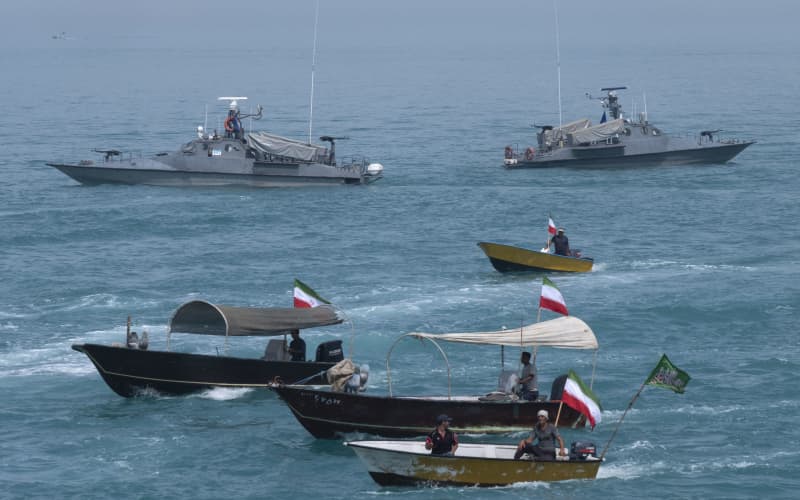
Two Islamic Revolutionary Guard Corps (IRGC) Navy warships and Basij paramilitary force speed boats are sailing along the Persian Gulf during the IRGC marine parade, which is commemorating the Persian Gulf National Day, near the Bushehr nuclear power plant in the seaport city of Bushehr, Bushehr province, in the south of Iran, on April 29, 2024. The Persian Gulf National Day, celebrated on the 10th of Ordibehesht in the Iranian calendar, usually falls in late April or early May and commemorates the expulsion of the Portuguese from the Strait of Hormuz and the Persian Gulf in 1622 by the Safavid forces led by Imam Quli Khan under the command of Shah Abbas I. (Photo by Morteza Nikoubazl/NurPhoto) (Photo by Morteza Nikoubazl / NurPhoto via AFP)
Two Islamic Revolutionary Guard Corps (IRGC) Navy warships and Basij paramilitary force speed boats are sailing along the Persian Gulf during the IRGC marine parade, on 29 April 2024. Photo: AFP / NurPhoto/ Morteza Nikoubazl

Iran has begun laying mines in the Strait of Hormuz, the world’s most important energy chokepoint that carries about one-fifth of all crude oil, according to two people familiar with US intelligence reporting on the issue.

The mining is not extensive yet, with a few dozen having been laid in recent days, the sources said. But Iran still retains upward of 80 percent to 90 percent of its small boats and mine layers, one of the sources said, so its forces could feasibly lay hundreds of mines in the waterway.

Iran’s Islamic Revolutionary Guard Corps, which now effectively controls the strait along with Iran’s traditional navy, has the capability to deploy a “gauntlet” of dispersed mine-laying craft, explosive-laden boats and shore-based missile batteries, CNN has reported.

A stock exchange curve appears on a smartphone screen, and a map shows the Strait of Hormuz on a laptop computer screen in this photo illustration taken in Athens, Greece, on March 3, 2026. (Photo by Nikolas Kokovlis/NurPhoto) (Photo by Nikolas Kokovlis / NurPhoto via AFP)
A stock exchange curve appears on a smartphone screen, and a map shows the Strait of Hormuz on a laptop computer screen in this photo illustration taken in Athens, Greece, on March 3, 2026. Photo: AFP / NurPhoto / Nikolas Kokovlis
The IRGC previously warned that any ship passing through the strait would be attacked, and the channel has effectively been closed since the start of the war. The state of the strait has been described to CNN as a “death valley” given the risks involved in transiting.

US officials said on Wednesday that the US Navy had not escorted any vessels through the strait, though President Donald Trump said on Monday that his administration was looking at options to do so.

Trump said in a post on Truth Social on Tuesday that “if Iran has put out any mines in the Hormuz Strait, and we have no reports of them doing so, we want them removed, IMMEDIATELY!”

He added that “if for any reason mines were placed, and they are not removed forthwith, the Military consequences to Iran will be at a level never seen before. If, on the other hand, they remove what may have been placed, it will be a giant step in the right direction!”

Following Trump’s post, Secretary of Defence Pete Hegseth posted on X that “at the direction of President Trump, @CENTCOM has been eliminating inactive mine-laying vessels in the Strait of Hormuz - wiping them out with ruthless precision. We will not allow terrorists to hold the Strait of Hormuz hostage. To the weakened Iranian regime: you have officially been put on notice!”

Trump also said during a Monday press conference that “the Strait of Hormuz is going to remain safe. We have a lot of Navy ships there. We have the best equipment in the world inspecting for mines.”

US Central Command said in a social media post later on Tuesday that the military destroyed multiple Iranian naval ships - including 16 minelayers - near the Strait of Hormuz.

Nearly 15 million barrels per day (bpd) of crude production, plus another 4.5 million bpd of refined fuels, are now effectively stranded in the Gulf, CNN has reported, and producers like Iraq and Kuwait have no alternative to shipping oil through Hormuz.

The G7 group of large economies have hinted they could move to release more oil to try to offset the shortages.

Uncertainty surrounding the ability to move oil through the waterway appeared to be causing severe volatility on the crude oil market on Tuesday, with the price per barrel fluctuating between more than US$90 (NZ$151) and less than $80 in a series of peaks and valleys.

-CNN