What you need to know about the $28b Auckland Transport Alignment Project
Thursday, 26 April 2018
Auckland is to undergo a $28 billion overhaul of its transport infrastructure, as its swelling population is forecast to reach 2 million by 2028.
With the clock ticking for a suitable infrastructure to accommodate such growth, the Government and Auckland Council announced on Thursday they would jointly fund the 10-year Auckland Transport Alignment Project (ATAP).
The project is due to begin this year. Here are the key points you need to know.

**READ MORE:
* Auckland Council, Government commit $28b towards Auckland transportation infrastructure
* Auckland public transport about to get greener
* Light rail promise for Mt Albert housing development praised**
TIMEFRAME AND COST
How long it would take to deliver the package?

The ATAP package is expected to be completed over the 2018 - 2028 period.
How is the project being funded?
Auckland Council has pledged to contribute $9.5 billion to the project, with almost 90 per cent of that coming from rates, development contributions and borrowing.
The Government would provide the remaining $18.5 billion, most of it coming from the National Transport Land Fund.
ROADWAYS
What would the northern corridor improvements look like?
Finishing the Western Ring Route would provide a new continuous motorway route between the Northern Motorway (SH1) and the Upper Harbour Motorway (SH18).
This is projected to reduce through-traffic from local roads in the North Harbour industrial estate area.
How would the Eastern Airport Access (SH20B) be improved?
This upgrade would provide an additional lane in each direction between Puhinui and the Airport.
What safety related projects would there be for the roads?
It is proposed that $910 million would be for safety-related projects and programmes.
The investment would be targeted to upgrading 10-12 high-risk intersections and 200 kilometres of high risk routes per year, provide more safe crossing opportunities, improving rural road safety, new speed management changes.
Would a congestion charge be introduced?

A report on the congestion charge question was competed in November last year. It looked at the scheme in cities such as London, Stockholm and Singapore, and found a charge has real promise to help address Auckland's transport challenges.
The Government and Auckland Council accepted the recommendation to proceed to the second phase of the project, where pricing options would be developed and evaluated. Public consultation is expected as the project progresses.
RAIL
What new rail projects would we see?
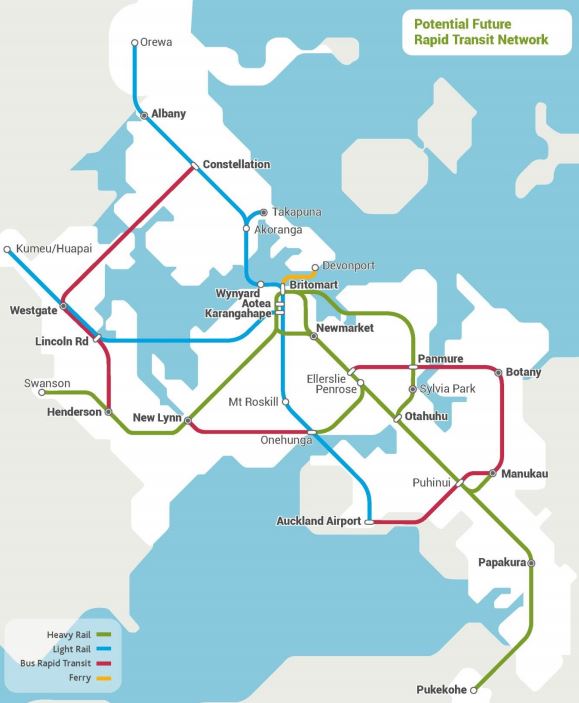
There is a proposal to introduce light rail on two major rapid transit corridors over the next decade: Airport - City and Northwest corridors.
Work wouldn't begin immediately because these corridors need significant investment; an allocation of $1.8 billion would be used to leverage funding and financing to progress both corridors over the next decade.
What is rapid transit?
Rapid transit is considered to be fast, frequent, high capacity services along corridors separated from general traffic and unaffected by road congestion.
Would they finish existing rapid transit projects?
Yes. The city rail link, an extension to the Northern Busway and the purchase of additional electric trains are committed and under way.
AIRPORT
What Is Planned For The Area Around The Airport?
The ATAP process has identified the need to improve access to the growing employment area at and around Auckland Airport.
The State Highway 20B corridor, which provides access to Auckland Airport from the east, would be upgraded and would include a high quality public transport link between the airport and Puhinui rail station in time for Auckland's hosting of major events in 2021 including APEC and the America's Cup.
BUS AND FERRIES
Does that mean there would be less buses on Auckland roads?

No. Although the share of public transport trips made by rail and light rail would increase over time, Auckland Transport says the majority of public transport trips are likely to continue to be made by bus.
Would bus journeys become more reliable?
Investment in the deployment of electric buses, double decker mitigation works, a Carrington Road upgrade and Sylvia Park bus improvements, is part of a general goal to improve the speed and reliability of the network.
Part of that improvement would come from more bus lanes, T2 - T3 transit lanes and providing buses with a head start at intersections.
What about more ferry crossings?
Not from this package, Auckland Transport is still sorting out the long-term approach to the city's ferry network. In the short-term, investment would focus on upgrading the downtown ferry terminal to address delays.
WALKING AND CYCLING
What's in the plan for walkers?
With a $900 million investment in walking and cycling infrastructure, amblers are projected to get general street upgrades and safety programmes to create safe, attractive places for more trips to be made in local centres.
And for cyclists?
Overall, around $640 million of investment in cycling infrastructure has been included in the ATAP Package, including the state highway corridor improvements.
Other investments include: SeaPath, SkyPath and a new walking and cycling crossing of the Manukau Harbour between Onehunga and Mangere Bridge.
TECHNOLOGY AND OPTIMISATION
What is network optimisation?
Essentially better technology can assist the road network to better cater for an increased usage, and has the potential to make the quickest impact on the problems.
Optimisation initiatives are likely to include traffic light optimisation, dynamic lanes – as recently implemented on Whangaparāoa Road – freight lanes and other priority measures, intersection improvements such as roundabout metering, and improvements to support bus priority or higher vehicle occupancy, such as T2 and T3 lanes.