How to recycle your plastic bags, when recycling can still mean landfill
Friday, 24 November 2017

Sometimes it's not easy being green. Even when you put your plastic bag in the recycling bin, it may end up in landfill.
About one in five councils in New Zealand accept plastic bags in kerbside recycling collections - but even among those that do, many are not able to actually recycle them.
Kapiti, Masterton, Carterton, South Wairarapa and Whakatane councils accept the bags in their recycling, only to sort them and send them to landfill. Horowhenua stockpiles the bags it receives while it searches for a recycler to take them.
But the Far North, Opotiki, Hutt City, Kaikoura, Hurunui, Christchurch, Central Otago, Gore, Invercargill and Southland councils do accept and recycle singler-use plastic shopping bags in kerbside schemes.
There are other options for recycling your bags if kerbside isn't available to you.
A scheme being gradually rolled out across the country now provides a recycling option within 20km of 74 per cent of households, even if your council isn't in the list.
The Soft Plastics Recycling Scheme, a joint initiative between the Government and the packaging industry, currently has 350 drop-off facilities around the Auckland, Waikato, Wellington, regions and across the South Island.
There are plans to expand across the central North Island within the next two years - and Stuff has become a sponsor to help make this happen, giving our subscribers improved access to recycling wherever they are.
There should be a recycling bin operating at every New World, Pak 'n Save, The Warehouse and Countdown stores, as well as Moore Wilsons, Farro and Huckleberry Foods in regions where the scheme has rolled out. You can find your nearest store with the locator here.
In 2017, the scheme collected 366 tonnes of soft plastics from around the country - compared to just 107 tonnes in 2016.
A spokesperson said: 'In December for the first time we collected over 11 tonnes per week. That's an uplift from 8 tonnes per week in September when we expanded the programme across South Island.' This has continued into January.

As well as plastic shopping bags, the scheme also accepts items such as bread bags, toilet wrap and frozen food bags.
But there's still some way to go. Compared to the 1.29 billion plastic shopping bags used by Kiwis every year, this is still a small fraction of the country's overall usage. The scheme is on course for hitting the project's objective of 447 tonnes by December 2019, but most of us aren't using it as much as we could.

HOW DO THE BAGS GET RECYCLED?
Soft plastics recycled through the scheme, which comprised 55 per cent plastic bags and 45 per cent food, goods and toiletry packaging, are currently sent to Australia.
There, recycling company Replas mixes the soft plastics with other hard plastic recycled materials to create a range of products including bollards, benches, traffic silencers, and decking.
Some of these are then sold back to New Zealand. Replas produced this table showing which councils have been buying their products:
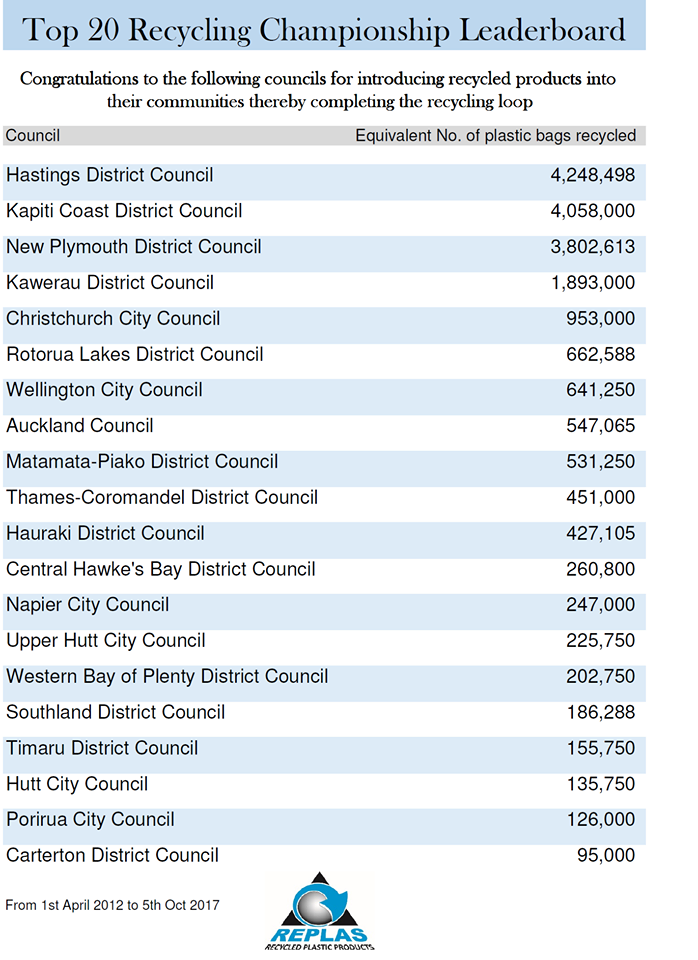
A Packaging Forum spokeswoman said the scheme was actively seeking a New Zealand recycler who could take the material, with the aim of running trials.
A Soft Plastics Recycling Scheme spokeswoman added: 'It's important for councils and industry to be buying the products which are made from the soft plastic packaging to create and sustain demand. Soft plastic is of no monetary value to recyclers so we need to make it worth their while to take it and remanufacture it.'
Council efforts to recycle bags and soft plastics at the kerbside are also hampered by a market that simply isn't hungry for the recyclable material.
Opotiki District Council takes all plastics, but a spokeswoman said those that were recycled depended on demands, which constantly fluctuated. Currently only New World bags could be recycled, and buyers were 'getting more and more reluctant to buy'.
'The only reason we have received for the reluctance to buy them is cited as changes in overseas demand… it costs a lot more to transport to market than we get from sales,' she said.
Horowhenua District Council has a similar issue. Environmental engineer Ryan Hughes said plastic bags and other soft plastics such as cling film were currently stockpiled because they were a difficult material to recycle and the market was oversaturated.
'Although council does not control the material once collected, we strongly discourage any landfilling of recyclable material,' he said.
A Whakatane District Council spokesman said despite collecting plastic bags at the kerbside, there was no market for the bags and they were separated, bailed and sent to landfill.
'We continue to search for a viable market and will continue to collect them in the hope that we do so.'
COUNCILS THAT ACCEPT CARRIER BAGS IN KERBSIDE RECYCLING
Far North District
Opotiki District - accepting only New World bags
Horowhenua
Hutt City
Kapiti
Masterton
Carterton
South Wairarapa
Kaikoura
Hurunui
Christchurch City
Central Otago
Gore
Invercargill
Southland
COUNCILS THAT DO NOT ACCEPT ANY SOFT PLASTICS IN KERBSIDE RECYCLING
Whangarei
Kaipara
Auckland
Hamilton
Thames Coromandel
Hauraki
Waikato
Waipa
Matamata Piako
Otorohanga
South Waikato
Waitomo
Taupo
Tauranga
Western Bay of Plenty
Rotorua Lakes
Kawerau
Gisborne
Central Hawke's Bay
Hastings
City of Napier
New Plymouth
South Taranaki
Stratford
Palmerston North
Ruapehu
Rangitikei
Wanganui
Manawatu
Tararua
Wellington
Porirua
Upper Hutt
Nelson
Tasman
Marlborough
Kaikoura
Waimakariri
Mackenzie
Selwyn
Waitaki
Waimate
Timaru
Ashburton
Buller
Grey
Westland
Dunedin
Queenstown Lakes
Clutha
Chatham Islands