Mismanaged retreat? The life-limiting limbo of Matatā's red zone
Friday, 12 July 2019
The oncologist told her to avoid stress. But here Puti Rowe is, sitting at the kitchen table weeping, a beanie cosseting her thinning hair.
She's been given eight months to live, but it's not her health she's worrying about. She needs to sell her four-bedroom home to buy a more manageable place for her husband Steven, who had a stroke and head injury 13 years ago.
But, like 33 other property owners in the tiny Bay of Plenty beachside settlement of Matatā, whose homes and sections have been red-zoned as a high natural-hazard risk, she's stuck in limbo-land. Unable to stay, unable to go, and unable to shed the constant stress of not knowing what's going to happen.
'I'm getting quite desperate,' the 66-year-old says.
**READ MORE:
* Climate change: Top lawyer says councils may soon be liable for climate damage
* The NZ council leading the way in determining how, when, where and who pays for climate change
* Councils need help with sea level rise, intense rain events: Productivity Commission
* Matata existing use rights cull one step closer after Bay of Plenty Regional Council decision

* Insurance likely to become a problem for homes on the edge of Wellington Harbour**
Across the main road from Rowe's house, Gregory and Pauline Fahey are living in a shipping container. They got consent in 2005 for a two-storey home, but all they've been able to build is a vege garden.
Pauline, 62, has early-stage dementia. She had to give up her job as a paramedic and they moved into the container as they could no longer afford to rent.
It's claustrophobic, Pauline says.
Now they could lose even the right to live in the steel box, as Whakatane District Council wants to buy out the residents to clear the area. They call it voluntary retreat, but if the residents refuse, the regional council could use the Resource Management Act to snuff out their existing land use rights – turfing them out without compensation.
It would be the first use of the RMA to force homeowners from their properties and no-one's quite sure if it's legal.


Councils around the country grappling with the growing threats of coastal erosion and sea level rise are watching Matatā as a precedent for what could work elsewhere.
.nsImageWrapper {position: relative; box-sizing: border-box; width: 100%; margin: 15px auto; max-width: 960px; font-family: 'Merriweather Sans','Open Sans',Helvetica,Arial,sans-serif; color: #333;} .nsImageWrapper img {width: 100%; border-style: none;} .nsImageCredit {font-size: 10px; text-transform: uppercase; color: rgb(162, 174, 180); text-align: right; font-style: normal; height: 1em; display: block; width: 100%; font-weight: 300;} .nsImageCaption {width: 100%; font-size: 14px; font-weight: 300; text-align: left; border-bottom: 1px solid rgb(235, 238, 240); padding: 0.8em 0 .58824em; line-height: 1.41176em; color: rgb(115, 120, 123); text-size-adjust: 100%;} @media only screen and (min-width: 841px) {.nsImageWrapper {font-size: 15px; font-size: 0.88235rem;}} @media only screen and (min-width: 300px) {.nsImageWrapper {font-size: 13px; font-size: 0.76471rem;}}

Nikki Macdonald
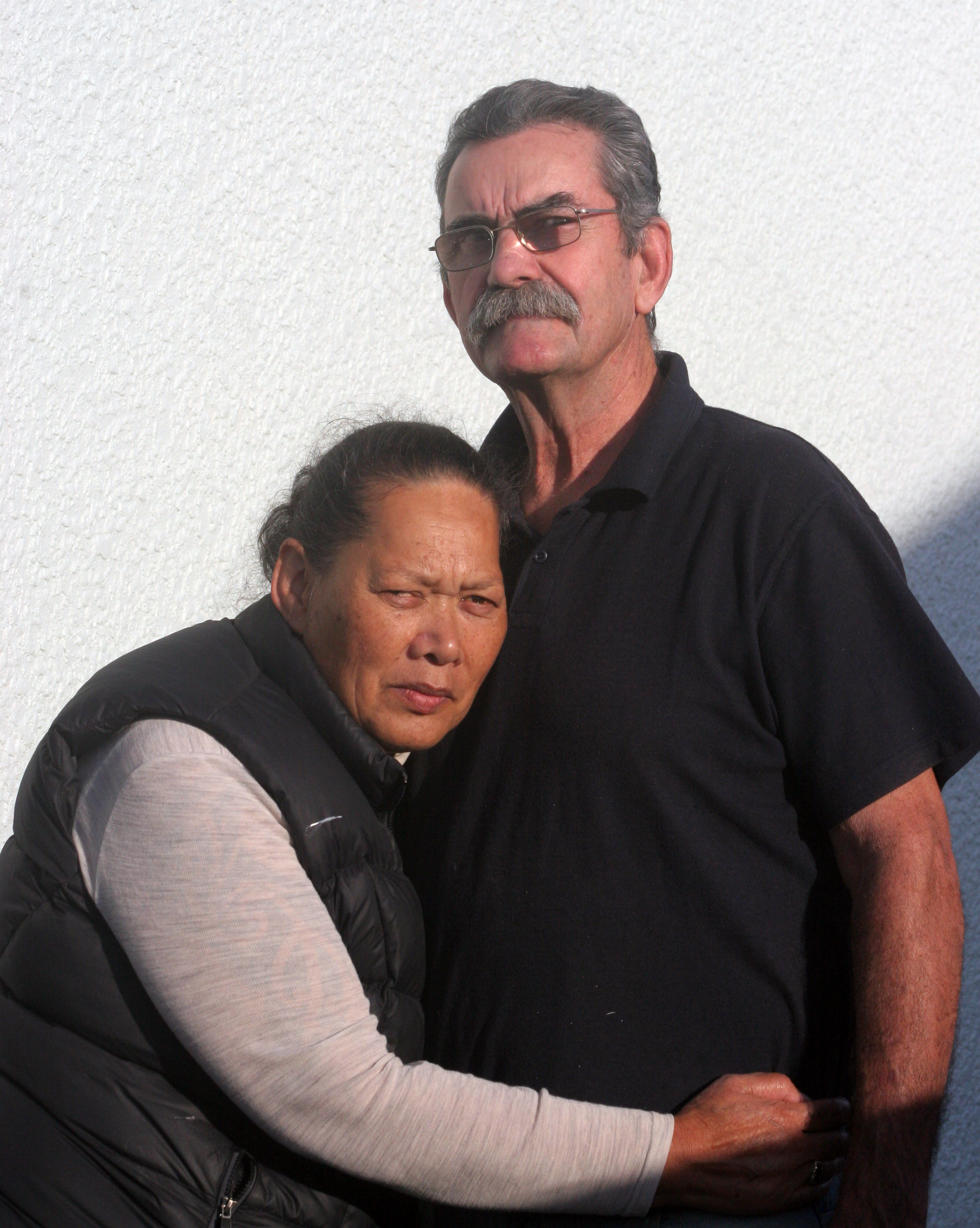
Gregory and Pauline Fahey are living in a shipping container, because they can't build on their land.

The Government is expected to decide next week whether it will contribute $5m to the expected $15m cost of buying out the residents, which could also set a precedent for future managed retreats. But the people of Matatā say the only thing other councils should learn from their misery is how not to do things.
While government funding would be good news for Rowe and others who just want out, the rest of the community is fixing for a fight.

'I won't be leaving,' 66-year-old Fahey says. 'I've told the council we want nothing from them. We just want to be left alone.'
Matatā is a one-pub, one-chippy town between Whakatane and Tauranga.
The quiet sea pulls at the beach, but there's a buffer of dunes between the ocean and the red-zone houses. That's not where the danger lies. White Island exhales its volcanic breath on to the horizon, but that's not where the danger lies either. Quakes rattle the homes, but that's accepted as a risk of living in New Zealand.

The danger comes from the 2-metre creek that cuts through the hills behind and winds through the houses of Pioneer Pl, Arawa St, Clem Elliott Dve and Richmond St.
Next to the Faheys is an empty section pocked with boulders and busted tree trunks. That's all that remains of the destructive debris flow that surged down Awatarariki Stream in May 2005, carrying two houses dozens of metres, hurling 7m boulders at a speed of 15-30kmh and depositing about 120 olympic swimming pools worth of silt, logs and debris.

But where once those streets ran thick with muddy filth, now they're coursing with anger and distrust.
Marilyn Pearce was in her parents' old place when the deluge went through. It was scary, but the fight with the council since has been far more traumatic, she says. More difficult even than having a sister and 3-year-old granddaughter fighting cancer.
Her property is absolute beachfront, with views sweeping the watery horizon. Her grandfather owned this land as the runoff to his farm. Her parents were here before her and in 2001 the family subdivided this acre into four. Her brother has the plot next door, her sister has the section behind, and cousins are neighbours.
When the debris flow first went through, there was a suggestion hers was one of four sections that could be taken for a chute-to-sea, to save the other properties. But that idea was abandoned. Had the council said then that the family could not rebuild, she would have taken the insurance money and built a new life elsewhere. She'd have been reluctant, but she'd have gone.
But now – like 25 of the residents who have banded together to raise legal funds – she's ready to fight.

Because instead of writing off the place as too dangerous in 2005, the council said it would find a solution to reduce the risk. So one by one, the residents returned. The Pearces reinvested their insurance money, took out a mortgage and spent $425,000 to build a shiny new 303sqm beachfront house in 2008. Marilyn's sister Lesley built in 2009. Her brother built in 2010. And then everything changed.
'We rebuilt. We fixed the houses that were damaged. And we moved on. And everything was fine, until 2012.'

In 2012, Whakatane District Council decided engineering options – first an earth dam and later a flexible net structure – wouldn't work. So residents in the debris flow zone were left with no protection.
That was bad enough, but then the council commissioned consultants to assess the risk to life from any future debris flow, and concluded the risk was 'intolerable'. So they set about getting the residents out.

In 2016, valuers assessed the properties, as if the debris flow never happened. Residents received offers, including contributions to legal costs and relocation.
Even as the buyout offers circulated, homeowners were told that if they didn't accept this one-time offer, the regional council could use the RMA to snuff out their existing use rights, meaning they'd have to leave anyway, but with no compensation.

As Pearce's neighbour Rick Whalley points out, that's like holding a gun to your head. The residents got T-shirts riffing off the Tui beer billboards: 'Voluntary Retreat – yeah right,' they read.
'What you're saying is: take the money, or you'll get nothing.'
Most residents say the 2016 offers were far from reasonable. The Whalleys were offered $700,000 – less than the house was valued at 11 years earlier. And there was no money anyway – the district council needs funding from regional and central government to cover the cost.
The district and regional council plan changes, which would force residents out, were set in motion in 2017. But they are now on hold until later this year, while the district council musters support for a buyout. But even if they get government and regional council funding and present fair offers, Whalley and his group plan to mount a legal challenge.
'If it was 2006 and the event had just happened and they were telling you you had to go, you would go. Not willingly, but knowing there's nothing we can do.

'But for them to say 'No, we'll fix it, spend all your money, go back and live a happy life' – and then to whip that away. You're going through the event twice … So that's why it's wrong and that's why I say we go back to court, because that's the right thing to do, because of what they've put people through – physically, mentally, socially …This land was stolen 178 years ago, and you want to steal it again.'

Rick and his partner Rachel moved to Matatā in 2012 to help Rick's mum Pam look after his ailing dad Bill. He spent his dying days stressing about the fate of the house he built in 1993, with savings amassed from a lifetime working in the mill at Kawerau. It's the whānau home – the place the grandkids come for Christmas and where they bring their pets to be buried.
The only damage to the house from the debris flood was a boulder in one garage. Flaxes and hibiscus have long since covered any silty trace.
'I'm not leaving,' 77-year-old Pam says quietly, serving tea and cupcakes from the lounge of her huge beachfront house, with its 180-degree view of the bay. She laughs that she and Marilyn will oil up and stand in front of the bulldozers, if it comes to that.
Round the corner at 104 Arawa St, Greig Thorby has more drastic plans. His dad bought the section in 2004, after three years of looking. It was supposed to be his last home, but now he's not allowed to build on it. Thorby took the place over last year, so his 82-year-old dad could escape the stress.
'It was supposed to be his retirement dream. It turned into his retirement nightmare.'
He's set up a shipping container on the section, with two bedrooms, wind power and a composting toilet. He's got the outdoor seating, without the house they should belong to. He hunches forward when he speaks, spitting anger and frustration.
In the 2016 buyout round the council offered less than he paid for the section. Even if they made a new, fairer offer, he wouldn't accept. Where would he go? They should just put the hazard risk on the Land Information Memorandum, and leave the rest to the property market, he says.

And if they try to push through the regional council plan change that would kick him off his land without compensation, he won't go quietly. He's already earned himself a trespass order from the council. Council officers say he threatened them – he denies that.
'They've already extinguished my rights – what use is a piece of land if you can't build on it? But what they are going to do is try and steal my land, without compensation. That's when the blood will flow. That's a licence for war. If they want to come here, who are they going to send – the police, the navy – to get me out?'
Jeff Farrell looks an unlikely villain. The round-faced Whakatane District Council strategic project manager shows a video of a debris flow, to highlight the difference between its destructive powers and your average flood.
With hindsight, the council should not have allowed residents back, he says.

'Having known what they do now, it's likely that managed retreat would have been the decision made in 2005. It would have overrode the residents' desire to move back at that point… I think for councils that are faced with decisions immediately after an event, I think the best thing is to pause for a minute and take a longer perspective about, is it reasonable, now that we know about this hazard, are we prepared to put up with these consequences? Or should we actually exit this area that we now know is a high hazard risk and encourage development in areas of lower risk and probably a better outcome longterm?'
The council did ask the Building and Housing Ministry (now MBIE) if it should prevent residents returning before a debris barrier had been set up, by declaring their houses dangerous. The agency advised the council could only prevent people living in their houses if injury or death was likely 'in the ordinary cause of events'. A one-in-200-500 year event did not qualify (smaller debris flows are expected more often).
The Earthquake Commission also questioned the idea of labelling buildings dangerous based on location, rather than building structure: 'If only location were to be considered, a great many existing buildings throughout New Zealand could be declared to be dangerous.'

So the council investigated debris barriers, and allowed residents to build back in the debris zone.
When they decided in 2012 that no engineering options were viable, they went back to MBIE, to determine whether people should be able to build on their sections. This time, the ministry said no.
A group was set up between council and six residents to consider options, such as early warning systems. They were also rejected as unworkable, but many residents still believe the council could and should reduce the risk, as it has done in other areas, such as Ohope.

The only option left was to move residents out. Farrell says while the council's preference was a voluntary buyout, it had a legal responsibility to reduce high natural hazard risks, once they were identified. That was a requirement introduced by the regional council, through its Regional Policy Statement.
The plan change process comprises two steps – firstly, a district plan change to rezone the area from residential to coastal protection, so people can't build on vacant sections. The second step – extinguishing existing residential rights – can only be done by the regional council, under the RMA.

In the case of Matatā, the regional council refused to initiate that process, leaving the district council to shoulder all the effort. Bay of Plenty Regional Council failed to respond to a request for comment.
Farrell wants better national guidelines to help councils deal with natural hazard risks – a growing issue as communities grapple with predicted sea level rise, flooding and coastal erosion.

'It's all very well for the government to sign up to the Sendai Risk Reduction Framework and say we'll promote disaster risk reduction over disaster risk response, and I think that's appropriate. But having done that, what does that mean in terms of consequence, and application and implementation? And there's been very little thought given to that space.

'So this district council is faced with having to work its way through a minefield of uncertainty, with unsupportive partners in a lot of ways.'
Farrell also advocates a national standard of risk when it comes to natural hazards that can kill, so property buyers, banks and insurers all know what they are getting into. And where the burden is too much for a local council, there should be procedures to enlist help, from regional and central government.
Christina Hanna is writing a PhD on managed retreat, and used Matatā as a case study. She found that forcing residents out immediately after the disaster would have been more efficient and less harmful to the community, but that overcoming the rebuild mentality is challenging. She also believes more national direction is needed to help councils decide when – and how – to walk away.

'That guidance is lacking from central government – in deciding the question of when, why, how and at whose cost. So councils are trying to figure this out along the way, but it's quite inconsistent and inefficient to be determining this across the country in different areas.'
There's also the legal question of whether the RMA can legitimately be used to extinguish existing use rights, effectively evicting people from their homes. If the Whalleys and others do test that in court, the precedent will be important, Hanna says.

'I think a lot of councils are waiting to see what's happening in Matatā to actually determine whether this is going to be an approach to use.'
Dr Judy Lawrence, of Victoria University's Climate Change Research Institute, says what has happened to Matatā residents is 'unconscionable' and highlights New Zealand's wilful blindness when it comes to fixing up problems we know will recur.
It also shows the problem with splitting planning roles between district and regional councils. To prevent the 'extraordinary gymnastics' between the two councils in this case, the law could be changed to allow both councils to extinguish existing use rights, Lawrence says.
District councils should also prevent new subdivisions in low-lying areas at risk of flooding, rather than leaving a nasty legacy for future generations.
'A line has to be put in the sand. It's really important it gets done sooner rather than later, to stop the horse bolting even faster.'
At present, all the Matatā owners can still get insurance. However, some have been denied bank loans. Insurance Council chief executive Tim Grafton expects companies will look after existing customers in natural hazard areas and, in the face of inevitable risks such as eroding cliffs, will increase premiums and excesses before pulling out altogether. He thinks banks are likely to withdraw – or restrict mortgages – first.
One of the biggest lessons from Matatā is the importance of communication. As Rick Whalley puts it: they do it to us, not with us.
Puti and Steven bought their place in 2009, on the understanding the council would put in debris barriers. It was a shell that they spent $400,000-$500,000 renovating, with council permission. Then the council said it wanted to buy them out, but not for what the house is worth.
She's been asking for a new offer since earlier this year. Just a fair offer, so she can live what's left of her life.
'It's very stressful. It's the not knowing. Nobody talks. It's just a waiting game … We're still paying rates and we don't know where we are. One minute everything is OK, then they change the goalposts. We can stay here. Now we can't stay here. I don't think any of the councillors would like to be in my position.'
On her bad days, Marilyn Pearce just wants to leave and be shot of the whole thing. 'It changes you,' the 65-year-old says. 'Because you're in fight mode all the time.' The stress, the weight loss, the sickness. She gave up her business and started smoking again.
If she got a fair payout, she reckons she'd buy a bus and drive off into the wild blue yonder. Other days, she holds tight to her kids' inheritance, the land passed down from her grandfather.
'They can't just take if off ya –- it would be a pretty sad day in New Zealand history if that happened, wouldn't it?
'It's been a bloody debacle, this whole thing. If other councils are watching this on how to do a retreat, they need to do it way, way, way better than this. Because if this is the learning curve for any other council in New Zealand, New Zealand is stuffed.'
WE'D NEVER HAVE BOUGHT
Tawai Thatcher and Ian Lockett moved into Clem Elliott Pl from Australia in 2015, to be closer to the grandkids. They knew about the debris flow risk, and that the council was not going to erect any barrier. They figured anywhere in New Zealand was risky, and they were happy to take that risk. But only months later the 'voluntary retreat' process started.
'If we had known what we know now, we wouldn't have bought here,' Thatcher says. 'We didn't come back to have all this over our head … We just want to get on with our lives.'
LOST LIFESTYLE
Michele and Paul Beach's girls were 2½ and 13 months old when their house floated on top of the debris flow and twisted on an eddy for 3½ hours. Michele and the girls climbed into the ceiling while Paul sailed the house as best he could.
They eventually climbed to safety on to a neighbour's roof. It was sheer terror, Paul says.
Now, they've bought a small cottage five minutes' drive away. It's half the size of the old place, which was demolished. It's Michele's family land and she wants to go back. The lifestyle where they are now 'sucks', compared to walking out the door to the beach. The daughter of a councillor, she's disgusted by the way the council has acted.
'I think they should just apologise for the bulls…, and walk away. Just leave us alone. Because they've done enough damage to us now. We're never going to get over it … Now to say 'Oh, we're going to take that land that your grandfather bought in 1953, that you inherited from your dad, we're going to take it and you're not going to have it' – how dare they?'
TOTAL RIPOFF
Victoria Humphries-Irwin and Wayne Irwin bought in 2009, having moved from Australia. They knew there'd been a debris flow but there was no talk of forcing people out, and they were happy to chance the risk.
They spent $150,000 renovating, before the council decided residents had to go. Their buyout offer was less than they paid pre-renovation and barely over half their $550,000 insured value.
'We've worked all our life to be ripped off, basically,' Victoria says. 'It's just been a whole nightmare. We can't do anything because we can't build, we can't borrow, we can't do anything. We were going to use this house as equity and just travel. Now we can't do a thing.'
A DIMINISHED COMMUNITY
Where Tom McGregor is standing, the hazard zone chomps a bite out of his section, meaning they can't do anything with it. He questions how modelling can be so precise that they can carve off part of a property. It will affect the property value, but they can't do much about it.
They wanted to build a new house, but worried that changing the footprint would affect their insurance. Instead, they're renovating.
Two homeowners on his street face eviction and he worries about the impact on the neighbourhood. 'We need people in the community for it to thrive.'