What we've learned about slow slip events since the November 14, 2016 quake
Monday, 13 November 2017
When the magnitude 7.8 earthquake struck on November 14 last year, the last thing on the minds of those who lost family members, homes or incomes would have been something called a slow slip event.
But slow slip events are a big deal. And New Zealand is possibly the best place in the world to study them.
Slow slip events are interesting for quite a few reasons.

'The discovery of slow slip events is probably the biggest discovery in seismology in the past 15 to 20 years and it's opened up a lot of interesting questions,' GNS scientist Dr Laura Wallace says.
**READ MORE:
* How Kaikōura triggered distant slow-slips
* Slow-slip earthquakes may provide the key for forecasting
* November earthquake kick-started slow-slip event

* Slow-slip earthquakes, like those in NZ, can relieve pressure**
They're essentially the same as a regular earthquake, but they happen very slowly, far below earth's surface, Wallace said. Over months or years, for example.

They are detected by GPS units permanently installed on the earth's surface.
In many cases, slow slip events involve plate movement equivalent to a magnitude 7 earthquake. In New Zealand, they happen every few years.

'There's this whole range of things happening on our plate boundary that we never, ever knew about and it has huge implications for trying to understand how movement between the tectonic plates is accommodated.'
In the Manuwatu and Kapiti regions, they last about one to two years. The longest in the world are in Alaska, where they can last up to five years, Wallace said.
'When slow slip events are happening, they are redistributing stress and pressure to different parts of the earth's crust and you can get earthquakes triggered by slow slip events.
'It causes a slight change in the rate of earthquakes in the short term, but over the longer term they're good, because they're relieving a lot of stress from the plate motion.'
Slow slip events can also trigger large earthquakes that were ready to occur by redistributing stress.
'People shouldn't freak out whenever there's a slow slip event, but it is possible that they can be accompanied by an increased number of earthquakes in some cases,' Wallace said.
One of the big questions scientists are grappling with is the relationship between slow slip events and earthquake triggering.
However, the opposite happened with the November 14 quake.
It caused a slow slip located between 250 kilometres and 600km away, on the shallow part of the Hikurangi subduction zone beneath the east coast of the North Island, off the Hawke's Bay and Gisborne coasts.
The slow slip happened less than 15km below the surface or seabed and spanned an area of more than 15,000 square km.
It stopped after up to 15cm of movement that was mostly finished by the end of November 2016.
Another slow slip caused by the November 14 quake occurred near Marlborough. By March the plate boundary in the area, about 25 kilometres beneath the earth's surface, slipped up to half a metre.
Yet another - this one beneath the Kapiti region - was also triggered. It's still happening and is expected to keep going for at least the next few months.
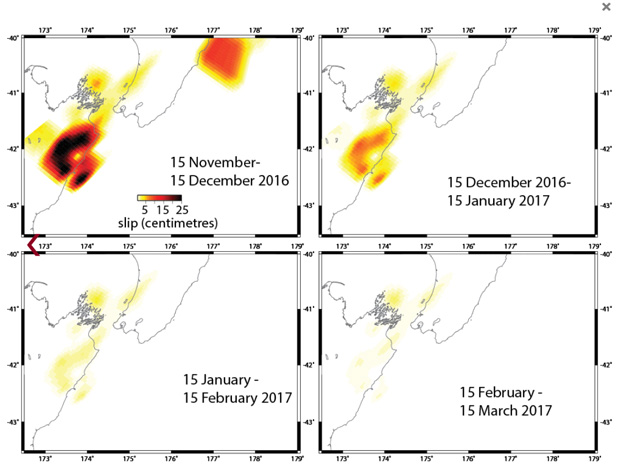
The November 14 earthquake started off a slow-slip event under Marlborough that has released energy equivalent to a magnitude 7.3 earthquake.
'I think it's giving us a lot more insight into the ability for earthquakes to trigger slow slip events,' Wallace said.
Slow slip events cause a slight increase in earthquakes in the short term when they are happening.
Over the long term, they reduce the overall number of earthquakes needed to accommodate plate motion.
Depending on who you're considering, what's important about slow slip changes.
What's important from a societal standpoint is that if we can really understand slow slips we could improve near-term forecasting of earthquakes, Wallace said.
'I think it's one of the few tools we could use to improve our ability to forecast [earthquakes]. Predicting earthquakes is simply not possible.'
From a scientific standpoint, the most important thing is that studying slow slip events helps understand how the faults involved work.
There are a few theories about why they occur.
Research in plate boundaries off the Gisborne coast in the next year will allow researchers to test those theories.
The properties of rocks in fault zones need to be researched. So does is the role of water coming into the fault zone and its effect on slow slip events.
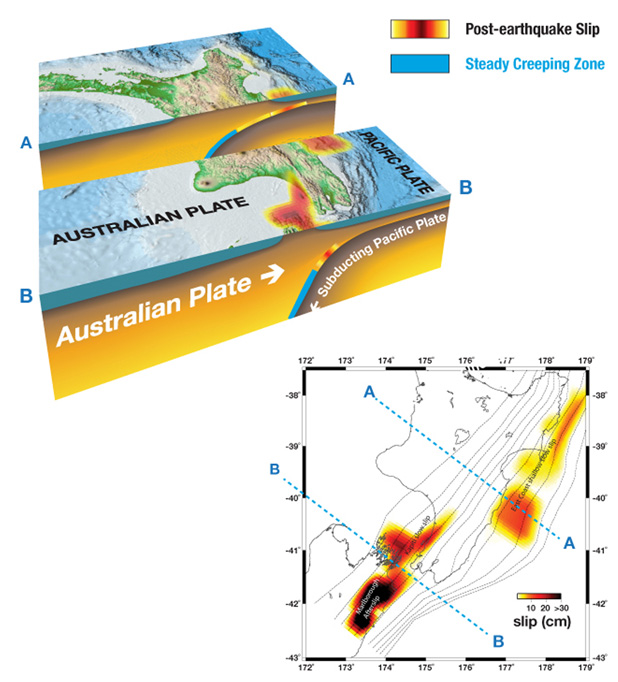
These diagrams show shere slow slip events have been occuring after the November 14 quake, and where steady creeping occurs.
USING SLOW SLIPS FOR GOOD
GNS seismologist Dr Matt Gerstenberger leads the national seismic hazard model - that's long term modelling used by insurance companies or in building standards.
He's also responsible for a lot of the GNS earthquake forecasting. Slow slip is data now being included to improve forecast accuracy.
That's a world first, making for interesting - and 'very challenging' - work, he said.
Slow slip information will be used in both short and long-term modelling.
'We know slow slip affects the earthquake rates when they are happening… so implicitly, there is [already] slow slip information in some of the models we are using.'
'Since [the quake] occurred, we have been looking at how we get that information in [to models].'
In a practical sense, short-term forecasts could help engineering response groups who were doing building inspections by giving them risk information.
Short-term information is also used by the government and businesses for planning.
It's important to remember predicting earthquakes isn't possible.
RESEARCH HOTSPOT
It turns out New Zealand is an ideal location to study slow slip events.
In other areas where they happen, they're often far offshore, deep under the ocean and the earth's surface, and extremely challenging to monitor.
New Zealand is well positioned to monitor then. Some have been found to be happening within a few kilometres of the earth's surface
Slow slip events and quake in general has attracted scientists from places like Japan and the United States.
Wallace estimates about 80 scientists have been working on research on slow slip events in New Zealand.
For those interested in earthquakes, the past year has been 'all hands on deck'.
Wallace says the November quake 'was so spectacularly complex, [it] has captured the imagination of of seismologists around the world as well. It's a pretty unprecedented earthquake.
'I think anyone who studies earthquakes in New Zealand or anything related to them can't ignore it, because it's a once-in-a-career event for some people.'
WHAT'S NEXT?
A ship funded by the International Ocean Discovery Programme - backed by 23 countries - is coming our way to conduct scientific drilling offshore Gisborne in December and January and from March to May next year, Wallace said.
US National Science Foundation ships will be carrying out seismic imaging of the plate boundary where the shallow slow slip is happening off Gisborne.
The aim is to build a detailed image of the plate boundary and its properties.
'These [projects] are really exciting and I think it's going to blow open our understanding of why slow slips are happening, which is something that we really don't understand yet.
'It's one of the big outstanding questions.'
Wallace said earthquake-related research in New Zealand has been receiving 'quite significant' funding from elsewhere - about $30 to $40 million so far.
A 2016 grant from the Ministry of Building, Innovation and Employment is providing support to the tune of $6.5m for slow slip and subduction zone research in the Hikurangi fault area.
However, Wallace believes there's a need for more investment in research.
'The subduction zone is potentially our largest earthquake and tsunami force and we currently have very little understanding of the earthquake and tsunami potential,' Wallace said.
'It could take decades to unravel all the questions… it's a long process.'