India Free Trade Agreement text revealed: What the Government says about the deal v what the secret text says
Trade Minister Todd McClay has confirmed the India Free Trade Agreement would not allow New Zealand to impose a specific cap on the number of student visas issued under the agreement.
However, he said the agreement would allow New Zealand to impose a cap on student visas from all countries including India, as long as it did not discriminate against India specifically.
The clarification comes after weeks of back and forth about whether the deal strips any future government from putting a cap on Indian student visas, which culminated in McClay telling Parliament the deal “does not restrict future governments from creating a cap should they wish to”.
The agreement’s text, which is yet to be published but part of which has been seen by the Herald, explicitly restricts either party from imposing a numerical limit on students from India to recognised education institutions – banning New Zealand from ever capping the number of student visas issued under the deal.
The current text is not final and is currently undergoing legal scrubbing.
McClay’s language appears to have confounded his own leader, Prime Minister Christopher Luxon.
When asked on Tuesday whether the agreement would “restrict the number of Indian students”, Luxon responded, “the agreement doesn’t restrict us from making any decisions that the New Zealand Government would make with or without the Free Trade Agreement”.
Asked the question again, he replied “no”, it did not prohibit a cap in future.
The text of the agreement says the opposite, that as a result of the agreement, a future government cannot cap Indian visa numbers.
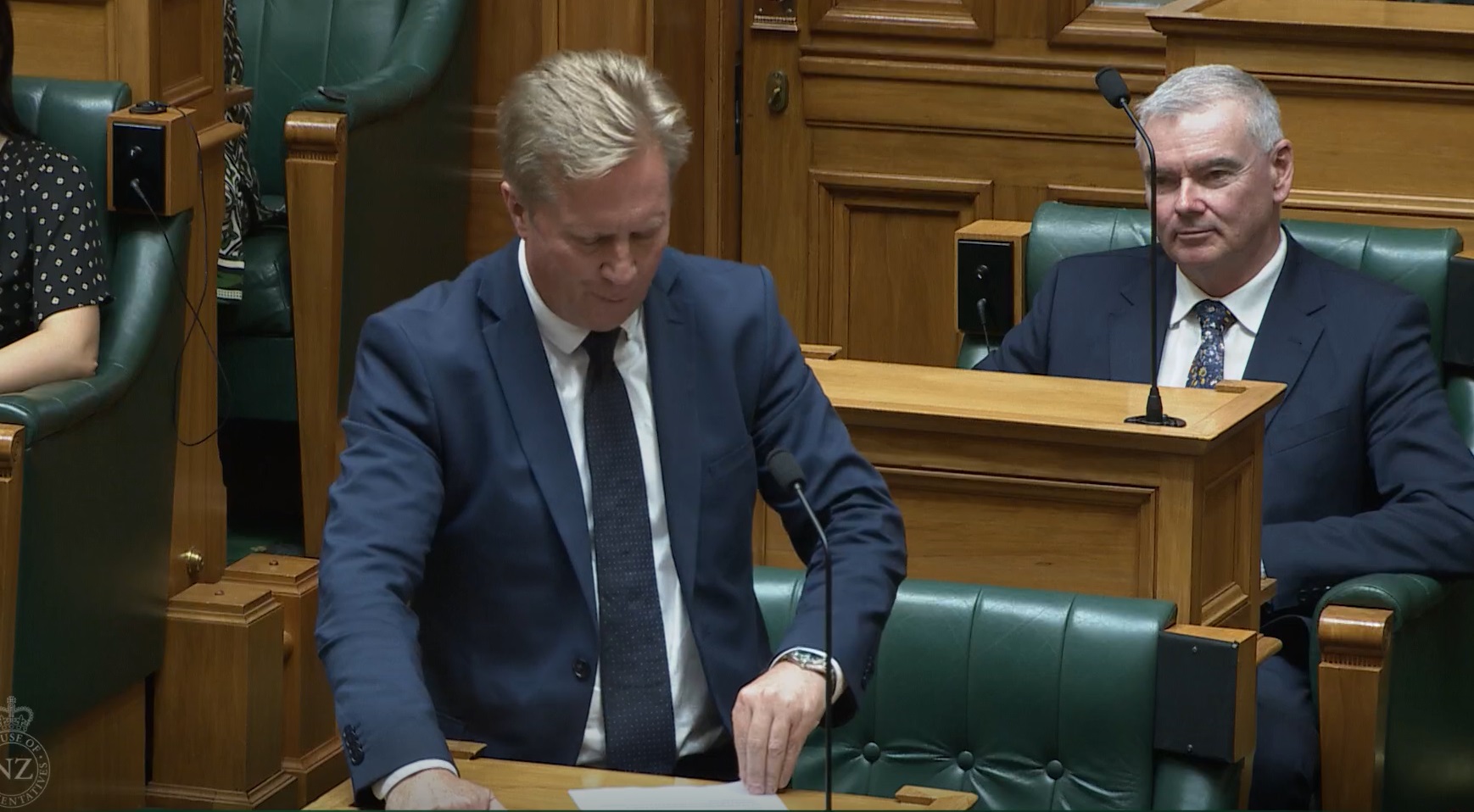
McClay has consistently denied that the deal would take away New Zealand’s ability to impose a cap on student visa numbers.
However, on Tuesday morning he conceded the agreement would prohibit New Zealand from imposing a cap on Indian student visa numbers specifically.
Speaking to Ryan Bridge TODAY on Herald NOW, McClay said, “if you look at a trade agreement, what it does say is that you can’t discriminate against one party versus others around the world, but New Zealand doesn’t do that”.
“In this sense, you’re right, we can’t discriminate against India,” he said.
McClay said the ability to change visa settings and impose an overall cap remained.
Foreign Minister Winston Peters, speaking as NZ First leader, told the Herald his reading of the trade deal was that the Indian Government’s description of the provisions relating to international students was correct. Indian media have reported the deal removes a cap – although there is not currently a cap on the number of Indian student visas and this appears to refer to the removal of the Government’s ability to ever impose one.
Labour leader Chris Hipkins said on Tuesday that his understanding was ”there is no provision that would allow New Zealand to impose a cap on the number of international students coming to New Zealand under the agreement”.
Hipkins said he wanted more information from the Government about that aspect of the deal.
It is not clear why McClay answered questions about the Indian deal with information about New Zealand’s general visa settings and not what the deal does to them.
Heading into caucus on Tuesday, McClay was asked whether the Government had the ability to cap the number of visas issued under the agreement.
“It would have to apply to all students that come to New Zealand, which is the current case,” McClay said
McClay on Tuesday revealed for the first time that NZ First, which opposes the deal, had received a copy of the text, with the party’s senior MPs given access to their agreement in their capacity as ministers of the Government.
“It has been provided to ministers within the Government including NZ First and Act,” McClay said.
McClay would not say when they were given access to the agreement. As recently as late January, no one in NZ First had seen the full text of the agreement.
McClay was also cagey about whether Labour, whose support National is relying on to pass the deal, had even been given a copy.
“Labour has had officials made available to them,” McClay said.
Asked specifically whether the party had been given a copy of the agreement they’d been asked to vote on, McClay replied, “I’m not getting into the details of that at the moment.”
It’s unclear why McClay was so cagey, as minutes later, Hipkins confirmed Labour had access to the agreement.
New Zealand has never in modern times capped student visas. During the pandemic, the Government closed the border first to China and then to other countries, effectively halting all migration.
In 2021, when the only way to get into the country was via a quarantine facility, the Government closed the border entirely to travellers from India – including New Zealand citizens.
Currently, there is no cap for any country on the number of student visas, with the only limit on student visas being the number of places at New Zealand tertiary education providers. Other visa classes, like Working Holiday visas, are capped with limits that depend on the country of origin.
On Tuesday afternoon, McClay confirmed on Heather du Plessis-Allan Drive on Newstalk ZB that there was a clause in the deal that said that “both sides will not do that [impose a cap]”.
“What I’m saying is the agreement and commitment is that we will not say that there is a maximum or a minimum [number of students],” McClay said.