Wellington Mayor Andrew Little commits to lowering commercial rates differential
Wellington Mayor Andrew Little has committed to a shake up of the city’s rating system to bring down the burden on business, but warns any change will not come soon.
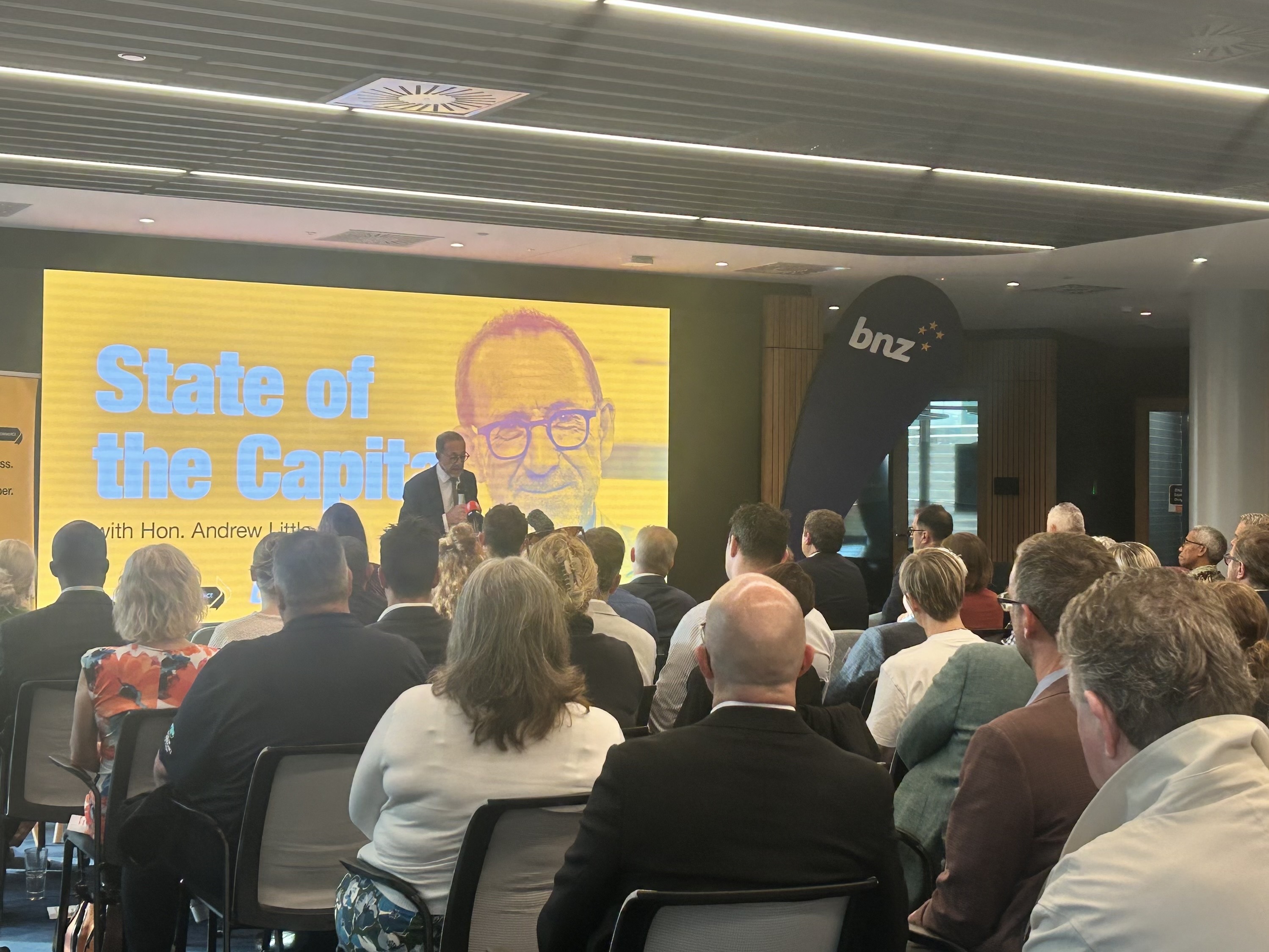
Addressing an audience of business high-flyers at a “state of the capital” address this morning, Little said the share of the rating pool businesses pay has “got out of whack”.
“I can’t be specific about timing, but I do say that I remain committed to seeing the differential reduced,” the mayor told the Wellington Chamber of Commerce event.
Rates are charged on a differential system, wherein properties are charged at different levels depending on their category of land use.
Residential properties are charged a base rate, while commercial and industrial properties are charged 3.7 times that level.
It equates to the capital’s commercial ratepayers being charged $20,000 more on average than those in New Zealand’s other main centres.
Businesses are covering about 48% of the city’s rates burden in Wellington, compared with Auckland and Canterbury where that number is closer to 30%, according to analysis by the chamber.
“In recent years, rates have increased at a pace that isn’t sustainable,” Little said.
“The problem is that once it goes up to defray costs that would otherwise fall on residents, it’s hard to go back. If we reduce the multiplier for the differential, we end up increasing residential rates by a significant margin,” Little said.
“That’s why getting spending under control is so important.”
Speaking to media after his speech, Little said Wellington’s 3.7:1 commercial rating differential was one of, if not the highest in the country.
“That starts to make it challenging for developers when they’re developing inner city land for commercial purposes. So if we can address that differential and bring the differential down, then we become more competitive,” he said.
While any changes would have to be supported by the full council, he said, he maintained a personal commitment to bring it down.
“I‘m confident that when we do the work on financial planning, budgeting, what have you, that in time we can do that,” he said.
In 2023, Wellington City Council officers said the city’s commercial rates differential was too high, but a proposal to drop it to 3.25:1 was voted down by councillors.
Little did manage expectations that any change would not come soon, saying when the reduction was last discussed a change would have resulted in a 4% increase on residential rates.
“So that’s the proportional effect of even a reasonably small change, so we’ve got a long way to go, a lot of work to do before we can make that shift.”
The high differential has long been a pet hate of the chamber, which has advocated for its reduction to attract investment into the capital.
The council’s chief strategy and finance officer Andrea Reeves last year said the council reviews the rating system annually and will continue to do so as the council works towards the 2027 Long Term Plan.
‘It’s easy to get into a funk about Wellington’
Speaking to a 100-strong audience, the mayor outlined his background, why he chose to take the city’s top job, and highlighted some of Wellington’s key challenges.
“Population in Wellington has been static, domestic tourism has been falling, economic growth has been the lowest in New Zealand, and council as an organisation has its own issues too,” he said.
“You can see how it’s easy to get into a funk about Wellington.”
He set the scene for more financial discipline on council, saying councillors were currently assembling their annual plan, and investigating how to bring down the rates bill.
Three new business advisory groups would be set up at the council as part of the triennium plan, the mayor revealed.
These would focus on property, infrastructure, and housing, technology, science, and innovation, and arts, creative, hospitality, and inner-city revitalisation.
It comes after the mayor scrapped the previous mayoral business advisory group, set up by former Mayor Tory Whanau.
Little earlier said that group was not working well after high profile resignations and claims it was not achieving anything.
Working with other councils to lobby central government over a bed tax was another potential revenue raiser, the mayor said.
Ethan Manera is a Wellington-based journalist covering Wellington issues, local politics and business in the capital. He can be emailed at ethan.manera@nzme.co.nz.