All Blacks v Wales: Will Jordan on the key to aerial dominance in Cardiff – Gregor Paul
THE FACTS
Gregor Paul in Cardiff
Beating Wales won’t necessarily bring the All Blacks much in the way of redemption, but they could restore an element of faith in their general direction of travel if they can definitively win the inevitable aerial battle that will break out at Cardiff’s Principality Stadium.
In their 12 tests so far this year, the All Blacks have yet to convince as a team who have found any degree of comfort in the critical art of catching or retrieving high kicks.
It’s maybe a sad fact of the modern game that booting the ball to the heavens in the hope possession will be regained has become a staple and quite often determining feature, but the trend seems unlikely to be reversed, and the All Blacks will continue to struggle to beat the best teams unless or until they develop a higher efficacy rate in regaining kick-possession.
Too often this season, they have been victims of their own technical failings – shelling high balls early in the game, which has encouraged their opponents to keep kicking to them.
That’s often had a compounding effect, where the All Blacks can’t get their hands on the ball and therefore can’t generate the faster tempo and greater aerobic content that is at the heart of their game plan.
Wales are well down on their luck and riddled with playing, political and financial issues, but despite their challenges and obvious limitations, they will likely be as good as their Home Union counterparts at kick-chase and present the All Blacks back three with another fierce examination of their aerial ability.
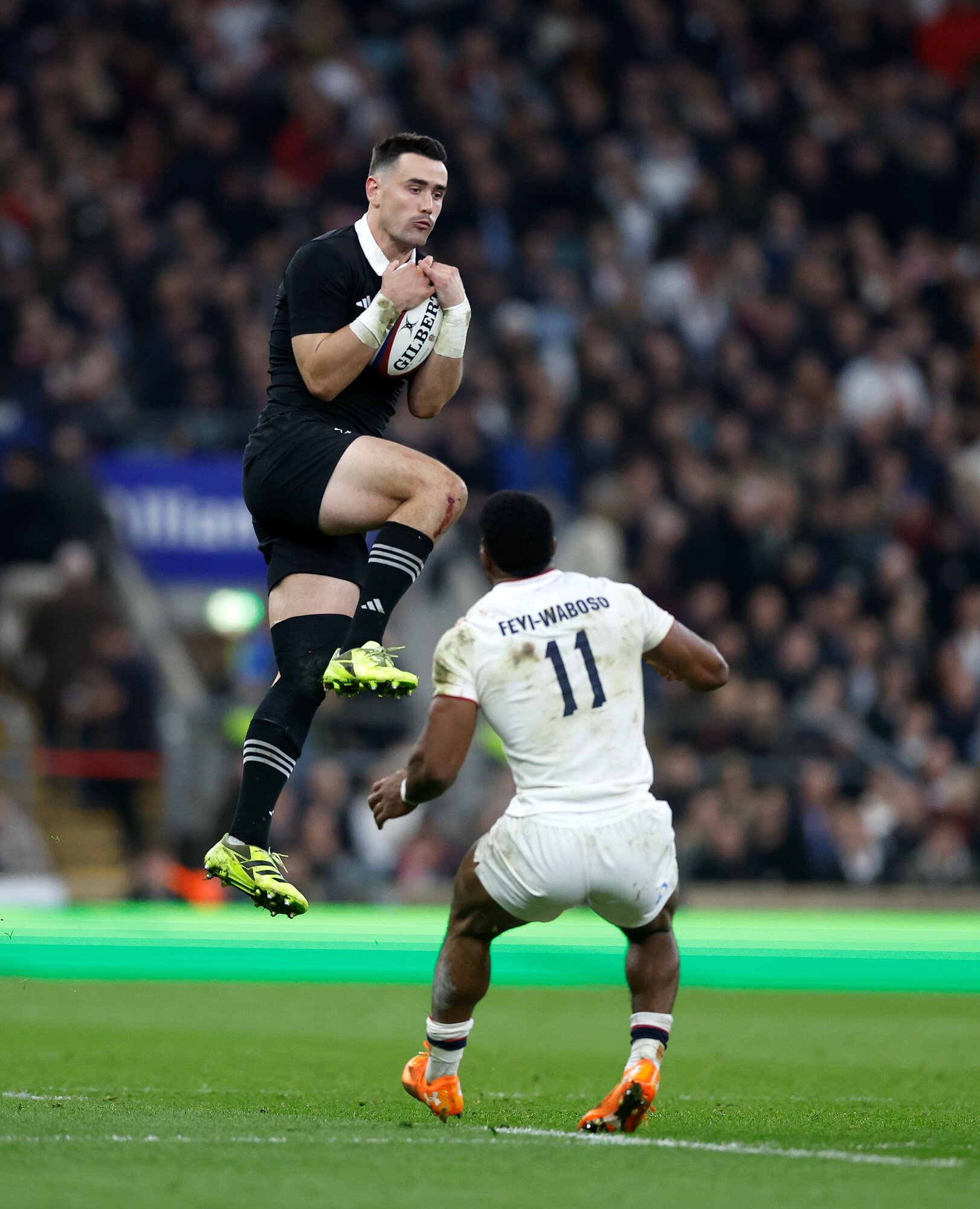
And while it won’t serve as a reason to recast the All Blacks season in a more flattering light should their selected back three of Ruben Love, Will Jordan, and Caleb Clarke deliver the requisite accuracy, it will at least engender the slight but growing hope that this is an area of the game New Zealand’s best players are capable of getting right.
From being wildly out of touch in their opening test of the season against France, the All Blacks have slowly improved their aerial game in the past few weeks.
It may not have seemed like that because there were so few clean catches, but Jordan – who has been ever-present in the back three and who will this week switch from fullback to wing – says the All Blacks, statistically, came out ahead of Ireland, Scotland and England in winning possession from high kicks.
“It is an interesting one, the high ball,” Jordan says. “The first thing to understand about it is that the game has changed around it.
“The laws have changed, so now there is a whole load of competing going on. In the last three tests, we’ve actually, statistically, won the aerial battle.
“The balls that have gone up, we have ended up with more than the opposition. There has been a bit of a perception about how we have handled it.
“If you had a look at the other games, personally, I am not really seeing another team whose back three are claiming a lot more than we are.”
The law change to which Jordan is referring is the clampdown on teams being able to block the area around the nominated catcher to make it difficult for opposition chasers to contest for the ball in the air.
Now, there must be an unobstructed path between chaser and catcher, which has created a genuine one-on-one contest, with the odds slightly weighted in favour of the chaser because there is value in their reaching up to try to deflect the ball back towards their teammates.
“The clean catch is the holy grail and what you are going for,” says Jordan. “The challenge for the most part is that the chaser is coming through with a hand high, looking to tap back.
“As the person coming forwards to catch, you don’t have that luxury because there are not guys behind you that you can tap it back to.
“A little bit of this now is physics – a person with a high hand against someone trying to catch it. If you can win the leap and get up, there are still opportunities to win the ball.
“If you consider, at the start of my career, you were looking to catch maybe 80%-100% of them, but maybe now those numbers have shifted a little bit.”
New Zealand have been slow to adjust and clearly have work to do on their technical ability as they have rarely managed to outleap their opponents and pull off many clean catches.
Where they have improved is in their ability to pounce on the ball when it has been tapped back or ricocheted somewhere after the initial aerial contest.
Jordan says that it has been a constant work-on for the All Blacks this year, learning how to get bodies around the catcher ready for the scraps, without being guilty of obstructing opposition chasers.
It’s hardly creative or innovative work, but it is hugely important and, really, given the issues afflicting Wales, the only real win the All Blacks can secure in Cardiff will be in the air.
Gregor Paul is one of New Zealand’s most respected rugby writers and columnists. He has won multiple awards for journalism and written several books about sport.