Scott Robertson exit: How All Blacks problems run deeper than coach
THE FACTS
As New Zealand Rugby begins what is effectively the fourth process in the past six years to appoint the All Blacks head coach, it’s impossible not to wonder whether the national body has become fixated with the belief that everything will come right if it finds the right leader.
This six-year period has been marked by a run of comparative under-performance by the All Blacks, which has led to the most turbulent coaching environment in professional history.
One head coach was removed from office halfway through his tenure, another was just about dumped shortly after signing a two-year extension, three assistant coaches have left mid-contract and another didn’t seek re-appointment.
From being the most stable and patient place for elite coaches, New Zealand has transformed into rugby’s version of the English Premier League where managers can last barely weeks before they are axed and have virtually no job security.
At the heart of this new, ruthless culture where coaches pay the ultimate price for results deemed below expectation is a conviction New Zealand still produces players of the requisite quality in the requisite volumes for the All Blacks to dominate the global game.
All this chopping and changing is really about NZR’s desire for the All Blacks to win the World Cup and its certainty that the talent to do so has always been there.
When former coach Ian Foster’s head was on the chopping block in August 2022, it was primarily because the All Blacks opened that year with two losses to Ireland and one to South Africa. With his side destined to play one or the other in the 2023 World Cup quarter-final, NZR’s board had to ask if they believed Foster had the capacity to win that tournament.
It was much the same earlier this year when the All Blacks finished 2025 having lost to England at Twickenham, while suffering a record loss to South Africa in a series split one-each.
Those results came into sharp focus when the 2027 World Cup draw was made in mid-December, putting the All Blacks potentially on track to play either the Springboks or England in the quarter-final if results go in accordance with the rankings.
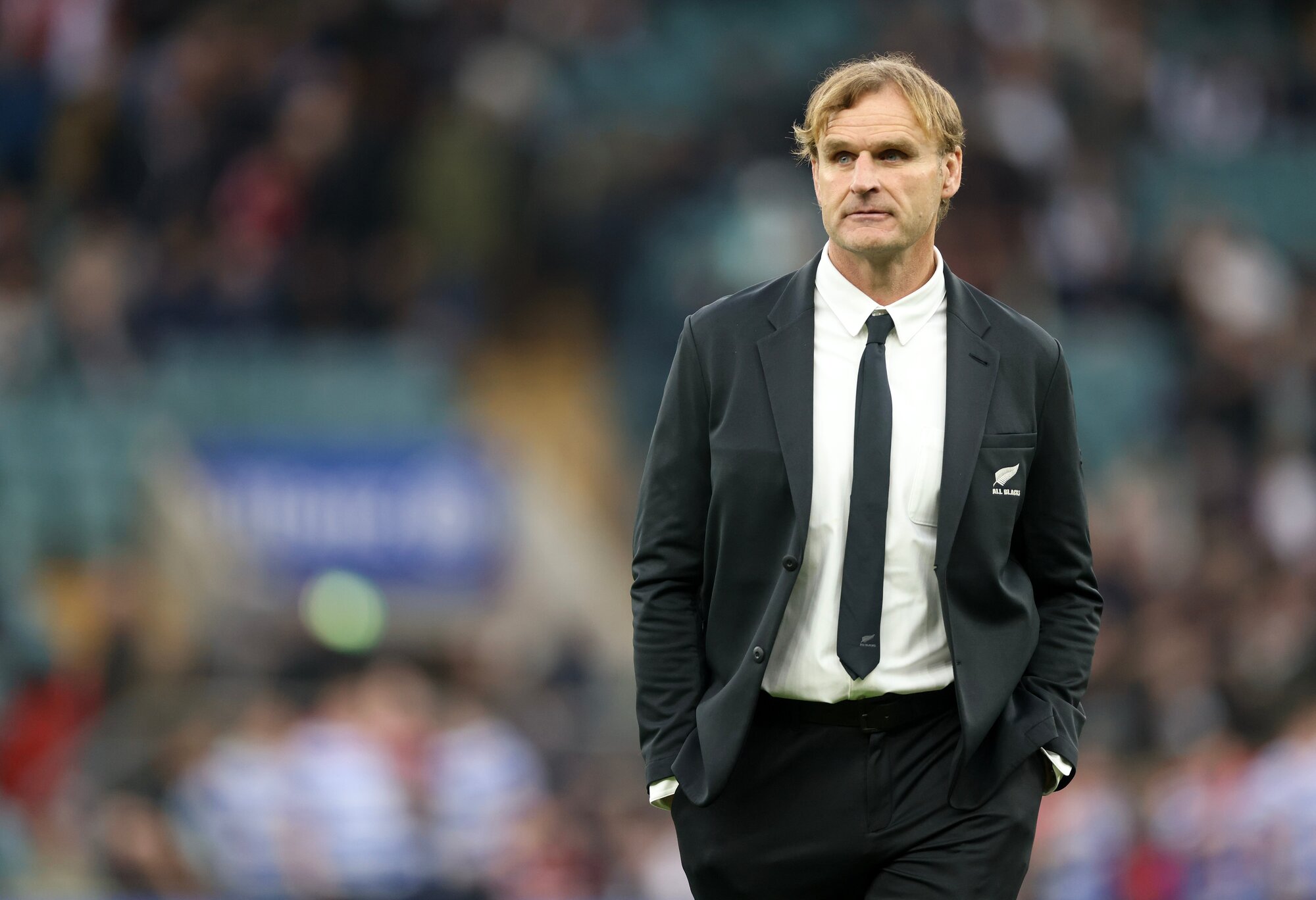
Obviously, given Scott Robertson’s fate, NZR’s board were unconvinced – based on chairman David Kirk’s statement that they were “not seeing the trajectory” – that Razor was going to steer the All Blacks past the last eight in Australia next year.
Now, two years out from the next World Cup, the contention the All Blacks have the players to win the tournament and just need the right leadership around them to be built into a cohesive, consistently, high-performing unit needs to be challenged.
Does New Zealand truly have the player base to knock over England and/or South Africa – and France, Ireland and Argentina for that matter?
Do the players collectively possess the right skill-sets to succeed on the international stage and are they capable of consistently doing the basics to a high level, while offering an occasional injection of X-factor to break a defence or change the flow of a big game?
Was it fair, in other words, for Robertson to be the fall guy for an All Blacks team that wasn’t necessarily performing with the accuracy, imagination, or consistency that the board needed to see?
Some question marks certainly hang over the players’ ability to kick and catch as well as the likes of South Africa and England – and use a co-ordinated and well-executed strategy to turn opposition teams with the boot and compete for high-balls both defensively and offensively.
But is this a skill-development issue – as in the individuals don’t have the ability to kick and catch – or was it a coaching failure to improve the competencies, combined with an inability to build a cohesive tactical plan for the players to follow?
The likelihood is that it was a bit of everything, and that it is a fixable issue, as there are technically competent kickers such as Beauden Barrett, Jordie Barrett, Damian McKenzie and Ruben Love in the mix, with Richie Mo’unga set to return later this year.
And this is largely why NZR is hopeful that a coaching change will deliver a major shift in performance – because the All Blacks largely have already got what they need to win the next World Cup.
Robertson wasn’t picking the wrong players in his wider squad, but he did struggle to select the right combinations and instil the right tactical vision, and the next coach is unlikely to stray too far from the incumbent group as the potential of the All Blacks is undeniable.
They have everything they need to play a modern, effective brand of rugby that wins tests as much as it wins the hearts and minds of fans.
They have incredible finishing ability in Will Jordan, but the incoming coach needs to keep upskilling his aerial work and improve his ability to make clean catches when he’s competing for defensive high balls.
Cam Roigard is developing into one of the best halfbacks in the world game, Ardie Savea remains a phenomenon in the back-row and his fellow loose forwards, Peter Lakai and Wallace Sititi, have incredible potential.
There is a glut of locks – so many that incumbent captain Scott Barrett needs to return from his sabbatical in top form to merit selection ahead of Tupou Vaa’i and Fabian Holland – and an equal abundance of athletic, mobile front-rowers who can pass, catch and run as well as scrum, tackle and cleanout rucks.
There are question marks at centre, where the new coaching team needs to find a way to either develop Rieko Ioane’s passing game; or play a style that better suits Billy Proctor’s all-court game, or invest in Leicester Fainga’unku and persuade him to be more circumspect with his decision-making; or trust in the experience of Anton Lienert-Brown to glue things together.
And there needs to be some tough but effective decisions made on the right composition of the back three – one that includes a genuine kick-catcher and organiser to give the All Blacks better counter-attack potential from the backfield.
But whatever decisions get made regarding selection, the All Blacks arguably have a good backline-in-waiting and the ability to sharpen their attack game into something more effective and creative than it was under Robertson.
Gregor Paul is one of New Zealand’s most respected rugby writers and columnists. He has won multiple awards for journalism and written several books about sport.