All Blacks coaching shake-up after Scott Robertson exit puts pressure on David Kirk –Paul Lewis
THE FACTS
It may be some time before we know the full ramifications of the demise of Scott Robertson as All Blacks coach, but one thing is clear: New Zealand Rugby, once hailed as overseeing the team known as the “Brazil of rugby” need to avoid being known now as the “Manchester United of rugby”.
That English Premier League club has moved through six managers in six years of humble results. Meanwhile, the All Blacks head coaches and assistant coaches flung off the fast-spinning coaching carousel in the past two-to-three years has now also reached six – Robertson, predecessor Ian Foster, jettisoned assistants Brad Mooar and John Plumtree and those who walked of their own accord: Leon MacDonald and Jason Holland.
It’s not a good look. It adds to increased perceptions in recent times that the old NZR regime panicked over the Foster-Robertson coaching succession; that the high-performance structure and its overall results are lacking; that the All Black coaching job is consequently not as desirable as it used to be; and that knee-jerk appointments are made instead of repairing the supporting infrastructure.
It will be one of the primary goals of new chairman David Kirk to fix all that. He moved decisively on a significant and uncomfortable coaching change in the middle of a World Cup cycle after a review – following Liam Napier’s Herald reports suggesting the dressing room had been lost.
That internal review may have been so damning and player feedback so trenchant that maybe Kirk had little choice. However, some will still feel a little surprised Robertson wasn’t retained, albeit with a group with far more international experience around him or even over him in the form of a director of rugby, for example.
That’s what happened with Foster. After a troubled 2022, he was persuaded to drop assistants Plumtree and Mooar, bringing in forwards coach Jason Ryan and strategy/attack guru Joe Schmidt. It worked: 2023 results were better, although changes to Robertson’s regime will go deeper than that.
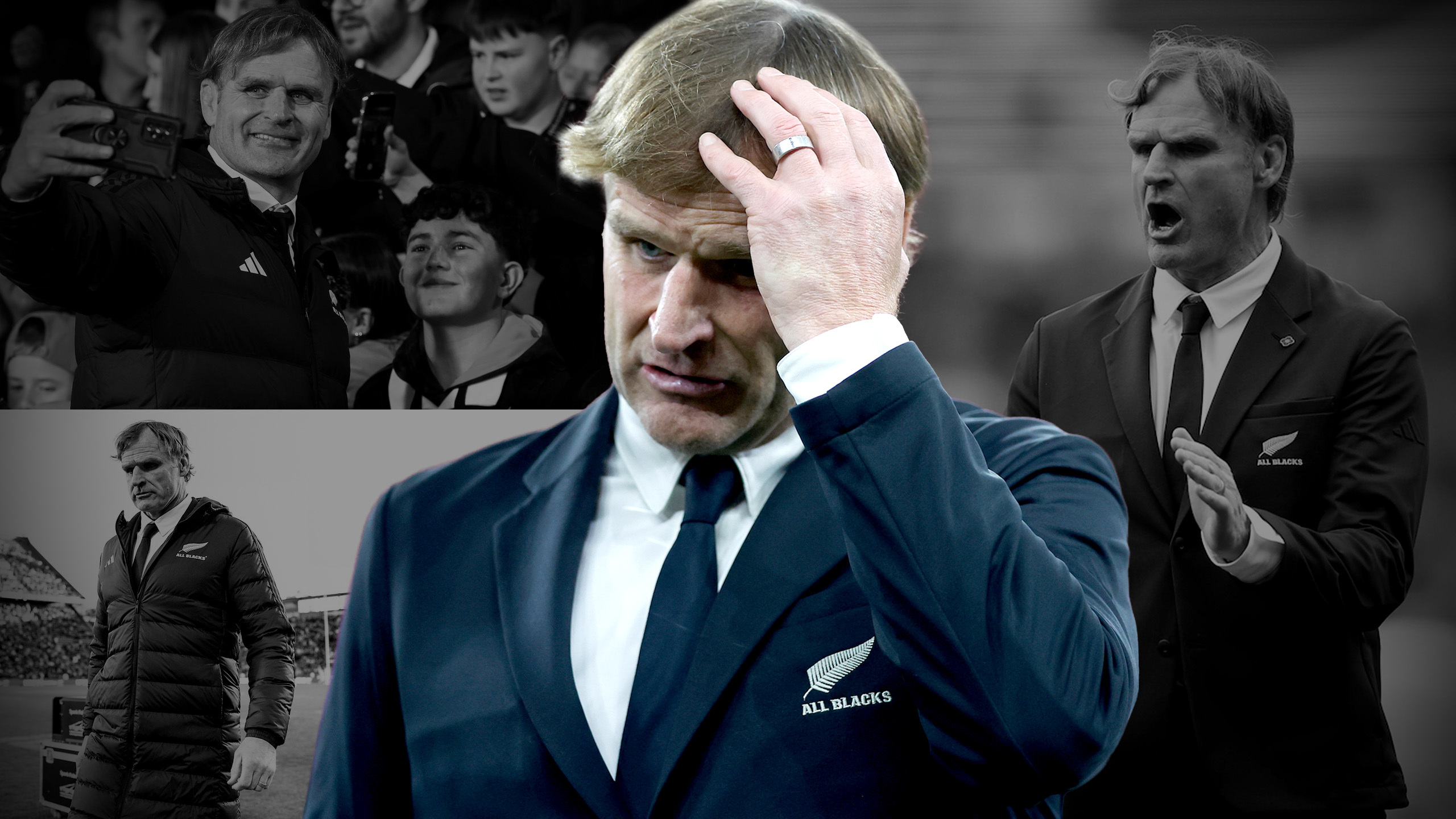
He structured his coaching group with himself at the top, rather in the style of an NFL coach or an EPL manager, both of whom do little hands-on coaching. It’s understood Robertson has denied that or at least diluted that perception but any such structure is now gone. It takes little imagination to see senior players wondering why, if they signed up with Scott Robertson, assistant coach Scott Hansen adopted the role of senior coach. Wrong Scott, surely.
Perhaps the mentoring candidates of Wayne Smith and Joe Schmidt were simply not available or have conditions. Smith’s last major rescue mission was to help win the World Cup with the Black Ferns, but he is 68 now and, although he was whistled in to help Robertson for a time before last year’s Eden Park win against the Springboks, he seems to prefer a part-time professorial/mentoring role. Schmidt is under contract to Australia until July and is standing down as Wallaby coach to spend more time with his family – something an All Blacks role inevitably makes more difficult. However, he may yet be an option.
The gossip suggests Jamie Joseph will take over as head coach and forwards coach Ryan may be retained. NZR are rumoured to be interested in freeing the innovative Tony Brown from his South African obligations. Dave Rennie is off-contract in Japan soon.
Any combo of Joseph-Brown-Schmidt-Rennie appeals, with Brown and Schmidt bringing huge intellectual property with them from the likes of the Boks, Ireland and Australia. However, it must be said there’s a lot of ground to cover yet before any of those appointments.
This is also a stern test for Kirk and his chairmanship. In normal circumstances a CEO would drive the process and bring a coaching appointment to the board but, with no CEO yet appointed, Kirk was cast as kingmaker and has laid down a marker here.
Kirk is a clear thinker with a successful business record, no stranger to pressure and tough decisions. He captained the Baby Blacks in 1986 after the schemozzle of the Cavaliers tour of South Africa. Passed over for the 1987 World Cup captaincy amid player politics emanating from that tour, he ended up being skipper after Andy Dalton’s injury, hoisting the inaugural World Cup at Eden Park.
He was also an integral part of John Hart’s record-breaking Auckland team and knows the value of organisation, strategy, attention to detail and player motivation. I can remember him firmly (but politely) upbraiding me during those days after I’d praised the pass of a rival halfback. A halfback’s pass was not just measured by length, he said, but by speed, accuracy and length. Fair enough.
The Robertson exit comes as the All Blacks face one of their most daunting schedules: four tests against the Springboks (and four games against South Africa major franchises), seven tests as part of the new Nations Championship (including France, Ireland and England), and two Bledisloe tests – 13 in all, only four at home. It’s tougher than a World Cup year.
Kirk wants consistency on the field, difficult in 2026. He must also clean NZR’s executive, commercial and high-performance stables, also no easy task. The cutting of Razor is likely the first stroke of many on which Kirk’s reputation will depend – and he will want to bury any further symptoms of Manchester United syndrome.
Paul Lewis writes about rugby, cricket, league, football, yachting, golf, the Olympics and Commonwealth Games.