Coalition checklist: 500 police, GE laws, stronger electronic monitoring among commitments up in the air
In the weeks following the 2023 election, the governing parties negotiated several coalition commitments to be ticked off by the end of the parliamentary term. With less than four months before Parliament dissolves, the Herald walks you through what’s been done, what’s been changed, and what remains – and likely will remain – unresolved.
The coalition commitment for 500 additional frontline police is seven months and nearly 200 officers behind deadline.
It’s one of a few coalition commitments that may not be completed by the end of this parliamentary term. Others include liberalising genetic engineering laws, which has stalled following New Zealand First concerns, strengthening electronic monitoring, and reforming Commerce Commission market studies to focus on reducing regulatory barriers to new entrants (all National-Act commitments).
Others have been dumped with minor party blessing, such as reversing the ban on live animal exports, which Act traded for tackling wilding pines.
Fees-free university study was switched to a final-year scheme, and then dumped altogether for trades-related training.
And while National was blocked from lifting the foreign buyer ban on residential homes, NZ First agreed to open the door for investors with “golden visas” to buy homes worth at least $5 million.
The National-NZ First commitment for 500 additional police was meant to happen within two years, or by November 2025.
As of June 1, half a year past the deadline, there were 10,515 full-time equivalents (FTE), only 304 more than the November 2023 baseline number.
“This does not include the 290 recruits that are currently under training,” Assistant Commissioner (deployment) Jeanette Park said. Police training takes about 20 weeks, with a 98% graduation rate.
She added the rolling 12-month attrition rate was 4.5%, down from a year earlier when it was 5.7%. This means about 240 constables are expected to leave the police by the end of the year, most of them retiring but about 25 (or 50 per year) crossing the Tasman to work in Australia.
The anticipated date for hitting the target was never really the actual deadline, and has been continually pushed back. It was early to mid-2026, according to Police Commissioner Richard Chambers in May last year.
Six months later, with the deadline approaching, Associate Police Minster and NZ First MP Casey Costello said the target could be achieved by May 2026, if attrition fell below 5% – which it has.
By then, the police expectation had moved firmly to mid-2026, but Treasury analysts thought September 2026 was more likely.
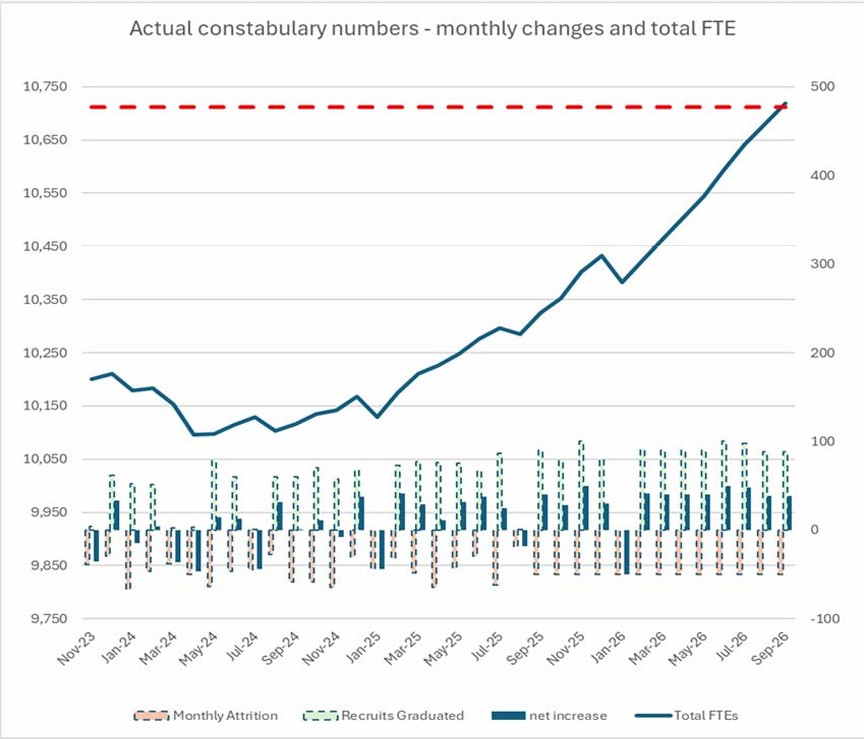
This was based on a trajectory at the time (September 2025) of 10,500 FTE constables by around April this year, which puts the current number about two months behind the forecast.
On the current trajectory, then, the target will be reached about November.
In a statement, Costello told the Herald that 1833 officers have been hired into the constabulary since December 2023.
“That speaks to the scale of the effort underway.
“The pipeline is strong, attrition is falling, and we are attracting experienced officers back. We’re in a good position and will reach the target in this term of Government.”
Regardless of whether the target is hit by the end of the year, maintaining numbers will be a challenge over summer due to a break in training between December and January.
Commitments still up in the air
The coalition agreements in November 2023 hint at the governing parties’ negotiating skills and the influence of minor parties Act and NZ First.
Many items were compromises, such as Act’s Treaty Principles Bill being supported no further than its first reading. Others were deliberately vague – to investigate or examine an issue, for example – indicating that nothing more concrete could be agreed on.
Advice was sought for having different degrees of murder, for example, but this National-NZ First commitment hasn’t led to legislative changes.
On the other hand, the vague promise to deliver public sector savings in the National-Act agreement is evident in the future 8700 job cuts announced in Budget 2026 (though the number of public servants increased 3% in the nine months to March 2026).
Most of the commitments in the National-NZ First and National-Act agreements have been ticked off or are being progressed.
Exceptions include:
The Government is currently progressing the Commerce Amendment Bill, but this would have the opposite effect to the promise in the National-Act commitment, according to the NZ Initiative.

Act is not about to bring down the coalition over failing to complete these two commitments. With limited time to progress legislation until Parliament dissolves, on October 1, the party wants to ensure the passage of health and safety, RMA and workplace relations reforms, the Herald understands.
Another that won’t progress is the promise to reverse the ban on live animal exports, which featured in both the National-Act and National-NZ First agreements.
National withdrew support after getting electoral cold feet, especially over the potential of losing urban votes to Labour over the issue.
Act instead negotiated a $79m boost for wilding pines control as part of Budget 2026.
In progress, or modified with party’s blessing
Some commitments still in progress include:
A NZ First spokesman said he expected updates soon on the first two matters.
A spokesman for Māori Development Minister Tama Potaka said a bill to change Waitangi Tribunal legislation will be introduced this term, a year behind schedule. Consultation opened last year, with a bill initially meant to be introduced at the end of last year.
One National-NZ First commitment has been modified, with NZ First’s blessing. Instead of ending the practice of concurrent sentences for offences committed while on parole, bail, or in custody, this is being encouraged.
This avoids the unmanageable impact the original commitment was expected to have on our bulging prisons.
Similarly, Act considers the Incentives for Growth Fund (paying councils for new housing consents) to have ticked the commitment to consider sharing a portion of GST on new residential builds with councils.

Act also approved of backing off the coalition commitment to move the Firearms Safety Authority to another department, which would have cost half a billion dollars. Instead it remains within police but as an independent entity.
One commitment that is unlikely to happen this term is the liberalisation of genetic engineering laws. The Gene Technology Bill was reported back from select committee at the end of 2024, but NZ First described the bill as “far too liberal” in its current form.
The commitment in the National-NZ First agreement was conditional on “ensuring strong protections for human health and the environment”, but there is no such condition in the wording in the National-Act agreement.
An NZ First spokesman said it would not be a failure if the commitment remains unchecked this term because it wasn’t party policy, and the condition was intended as a safety net for what Act was pushing for.
This is different to the Regulatory Standards Act, for example, which is in the National-Act agreement but absent in the National-NZ First agreement. NZ First therefore felt compelled to vote for it, but has since promised to repeal it.
“You’ve only got so many cards,” leader Winston Peters told Waatea News last year. “We did our best to neutralise its adverse effects and we will campaign at the next election to repeal it.”

The best of the rest
There remain dozens of policy wins for Act and NZ First to highlight over the election campaign as evidence of their respective influences in the Beehive.
Among them for Act are the shrinking of the public service, the red tape-cutting Ministry for Regulation and the Regulatory Standards Act, a rewrite of firearms laws and regulations, and a national conversation about Treaty of Waitangi principles following its high-profile Treaty Principles Bill, which was defeated at second reading.
Asked to highlight his party’s biggest wins, Act leader David Seymour noted the expected shrinking of the public sector in coming years “saving billions of dollars in government waste, setting the agenda for fewer public servants and departments, and stopping the introduction of any new taxes”, which all contribute to the forecast surplus a year earlier than previously expected.
He also highlighted Pharmac and greater access to medicines for hundreds of thousands of patients, the reintroduction of charter schools, and promoting “equal rights for all, with need not race at the centre of government service delivery”, among other things.
Seymour acknowledged that other governing parties supported these moves as well.
“In each of these areas, the Government hasn’t gone as far as Act would alone, but it’s gone a lot further than it would have without Act.”

NZ First can boast about, among others, the $1.2b Regional Infrastructure Fund, a funding boost for Foreign Affairs despite cuts across the rest of the public sector, a review of Treaty of Waitangi clauses in 19 pieces of legislation, keeping superannuation eligibility at age 65 as well as SuperGold card upgrades, and 500 extra police (or at least efforts and funding to recruit them).
Peters declined to highlight any specific policy wins, saying instead that NZ First has fought for “nationalism, social conservatism, patriotism, and common-sense policies”, while “fighting against the woke, communist, racist, and globalist left”.
“They [voters] can see the value in a patriotic party like New Zealand First who put the New Zealand people first in all of our policies, not fit them into some sort of globalist agenda,” he said in a statement.
“And just as important, we don’t have to belatedly take credit for other parties’ policies – like others are needing to do."
Derek Cheng is a senior journalist who started at the Herald in 2004. He has worked several stints in the press gallery team and is a former deputy political editor.